
In short
- Keep wide photos for room context and close views for individual damage, taken only from safe locations.
- Pair your technician's dated moisture readings with a written scope so visible damage and drying work have separate records.
- Save receipts and a simple log together, with copies of the documents sent to your insurer.
Start the Call and Build the Record Alongside Cleanup
Call about water damage now and gather paperwork alongside the assessment rather than delaying help to finish a folder. Your technician documents the condition of wet materials and explains the proposed work. Keep your observations in a simple log, and add professional records as they arrive.
Separate what you saw from what the assessment establishes. A note such as "water along the bedroom baseboard when I entered" records an observation. The technician's moisture readings and scope describe the condition of the wall and the work required.
Choose Wide Photos, Close Views, or Video
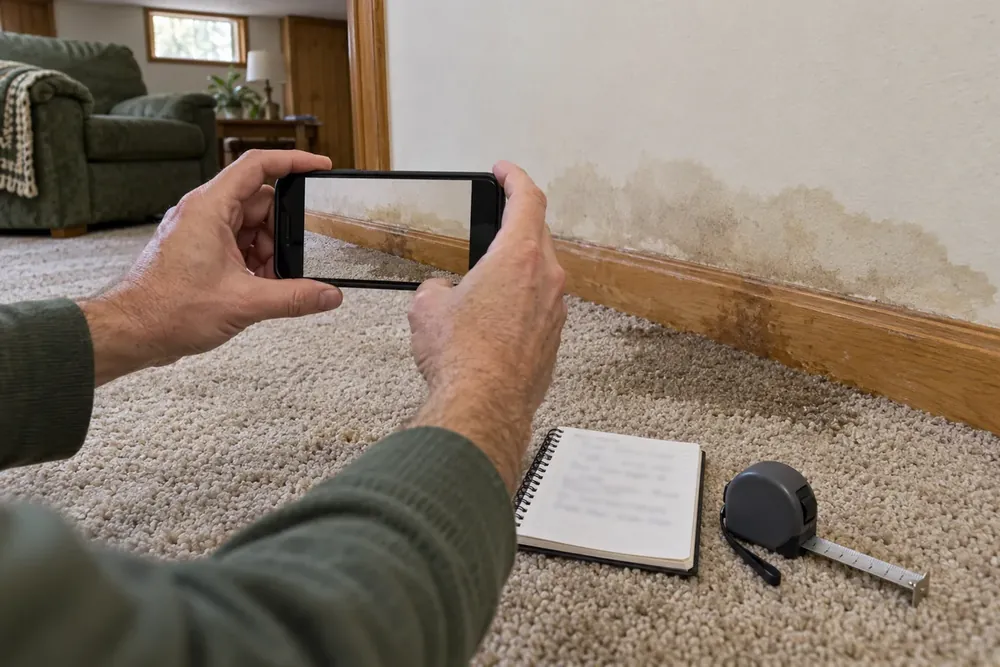
Wide photos locate the damage within a room, close views show individual details, and video records a sequence of views. Choose the format that shows the condition clearly without entering an unsafe area. A few organized images are easier to follow than many unlabeled versions of the same stain.
| Record | What it shows | Useful label |
|---|---|---|
| Room photo | The affected area in relation to the room | Room name and date |
| Detail photo | A damaged item, trim edge, or visible stain | Item or wall location |
| Short video | How visible damage extends across a space | Rooms shown and recording date |
Keep the original files. Label copies with plain descriptions instead of adding conclusions about the cause. If damage changes during drying or removal, add dated images rather than replacing the first ones.
Pair Moisture Readings With the Written Scope
Moisture readings document material condition, while the written scope identifies the planned drying, removal, and repair tasks. Ask your technician to identify the room and material associated with each reading. A number without a location is harder to compare with a later measurement.
For a wall dried intact, keep the initial assessment and subsequent readings. For a wall opened to reach wet insulation, also keep photos of the opening and the scope describing removal. Record replacement and finishing separately so the sequence from assessment to repair remains clear.
Keep Receipts and a Simple Dated Log
Receipts document purchases and completed work; a log records when observations, visits, and conversations occurred. Store both with the scope, using dates and room names that match the photo labels.
- Save itemized invoices and receipts in their original form.
- Note the date, person contacted, and documents requested during each conversation.
- Retain updated scopes alongside earlier versions, with the revision date visible.
- Keep copies of documents sent to your insurer and the date sent.
Use one folder for the overall event, then separate photos, drying records, repair records, and correspondence. That arrangement keeps different types of evidence easy to find without making a complicated filing system.
Keep Copies of What You Send
Keep copies of the organized damage records you send to your insurer, with the submission date noted. Label documents and correspondence by date and room. Ask which records they need and their preferred submission method.
Your technician supplies documentation of conditions and work. Keep those records with your dated log and receipts. If a record lacks a date, room name, or description, request that missing detail while keeping the original document. For immediate damage steps alongside paperwork, see the first hour after water damage.